Can I Prune or Fell My Tree in London?…
The mature plane tree at the bottom of the garden has thrown the kitchen into shade, dropped its sticky seed balls across the patio for the third year running, and finally dropped a branch onto the shed roof. The saw is in the garage, the weekend is free, and the temptation to simply deal with it is strong. In a great many London gardens, though, that instinct can land you in serious trouble – because the tree you think of as yours may be protected by law, and cutting into it without permission is a criminal offence rather than a private decision.
London is unusually full of protected trees. Centuries of leafy squares, Victorian streets and carefully designated neighbourhoods mean that a large share of the capital’s gardens fall under one of two overlapping systems of control: Tree Preservation Orders and conservation areas. The good news is that most sensible tree work can still be carried out. The catch is that the order of events matters enormously, and the safest move is always to find out where you stand before a single branch comes down.
What a Tree Preservation Order Actually Does
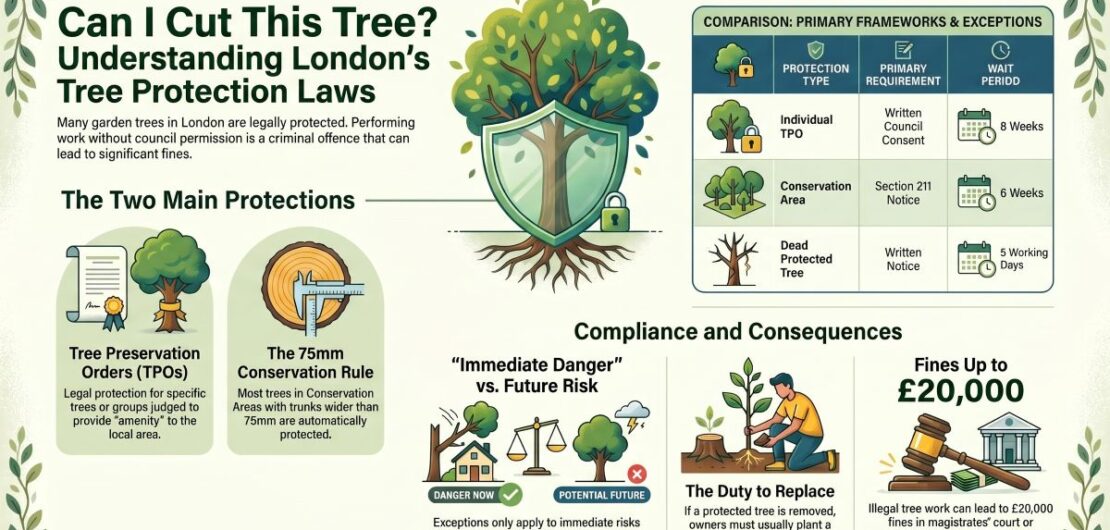
A Tree Preservation Order, almost always shortened to TPO, is a legal protection placed on a tree by the local planning authority – in London, that means your borough council. The power comes from the Town and Country Planning Act 1990 and the regulations that sit beneath it, and a council can make an Order whenever it judges that keeping a tree is, in the wording of the legislation, expedient in the interests of amenity. In practice that covers any tree contributing meaningfully to the look and character of an area, which in a green but crowded city is a great many of them. When a council makes an Order it must notify the tree’s owner, who has the right to object or comment before it is confirmed; even so, the protection usually takes effect provisionally the moment the Order is served, so work cannot simply be rushed through while the paperwork is still pending.
An Order can apply to a single specimen, to a group of trees, or to an entire woodland. Once it is in place, you cannot cut down, top, lop, uproot, or wilfully damage or destroy the tree without the written consent of the council. That holds true even when the tree stands entirely within your own garden, and regardless of who planted it or how long ago. Inheriting a protected tree when you buy a property is common in London, and not knowing that an Order exists is no defence if you breach it.
It is worth being clear about what a TPO does not do. It does not freeze a tree in place forever or forbid all work. Councils regularly grant consent for pruning, crown reduction and even felling where the case is sound. What the Order does is move the decision out of your hands and into a formal process, so that the work is assessed before it happens rather than regretted afterwards.
Conservation Areas and the Protection You Might Not Know About
The second system catches far more Londoners by surprise. Large parts of the capital, particularly across inner boroughs such as Camden, Islington, Kensington and Lambeth, are designated conservation areas, and trees within them carry a layer of protection even where no individual TPO exists. Any tree with a trunk diameter of more than 75 millimetres, measured at 1.5 metres above the ground, is automatically covered. That threshold is low enough to include most established garden trees. Smaller trees below that size, along with a few specific operations, fall outside the requirement, but the protection is otherwise a blanket one, covering every qualifying tree in the area at once. Where a tree is both in a conservation area and subject to its own TPO, the Order takes precedence and you follow the consent process rather than the notice route.
Before pruning or felling such a tree, you must give the council six weeks’ written notice, known as a Section 211 notice. This is not the same as applying for consent. The council cannot grant the notice with conditions attached, but during those six weeks it can decide that the tree deserves a Tree Preservation Order and make one, which then shifts the whole matter into the TPO consent process described above. If the six weeks pass without the council making an Order, or it confirms sooner that it has no objection, you are free to carry out the work as described, and you then have two years in which to do it.
How to Tell If Your Tree Is Protected
Checking is straightforward and costs nothing. Every London borough keeps a register of its Tree Preservation Orders and a map of its conservation areas, and many now publish both online so you can search by address in a few minutes. A local land charges search, of the kind carried out when a property changes hands, will also reveal any Orders affecting the land. If you cannot find a clear answer, or the records are ambiguous, the sensible course is to treat the tree as protected and ask the council’s tree officer directly before doing anything. Assuming a tree is unprotected because you cannot immediately find the paperwork is a risk that sits entirely with you.
When You Can Work Without Permission
There are genuine exceptions, but they are narrower than people hope, and the burden of proving them falls on whoever carries out the work. The clearest is a dead tree, which may be removed without consent – though for a tree under a TPO you must still give the council five working days’ written notice beforehand, so that an officer can confirm it really is dead. Removing dead branches from an otherwise living tree needs neither consent nor notice.
A dangerous tree is the exception most often misunderstood. The law allows you to carry out the minimum work necessary to remove an immediate risk of serious harm without waiting for consent, but the key word is immediate. A tree that might fail in a storm next winter does not qualify; one that is actively splitting, or has been destabilised and threatens people or property, does. Anyone relying on this exemption should photograph the tree thoroughly before and after, keep any arborist’s assessment, and notify the council in writing as soon as is practical. Claiming you assumed a tree was dead or dangerous will not protect you if the evidence does not bear it out.
A handful of other exceptions exist, including fruit trees grown for the production of fruit where the work follows good horticultural practice, and certain works needed to carry out a development that already holds full planning permission. For most homeowners, though, the practical rule is simple: if the tree is alive and not an immediate danger, assume you need to go through the proper channels. It is also worth knowing that misusing an exemption is an offence in its own right, so where there is any doubt about whether a tree is truly dead or dangerous, written confirmation from the council or a report from a qualified arborist is far cheaper than a prosecution.
Consent, Penalties and the Duty to Replace
Where consent is needed, the process is less daunting than it sounds. Applications and Section 211 notices are made to the borough council, usually through the national Planning Portal, and there is no fee for either. You describe the tree and the work proposed, and the council assesses the effect on the wider amenity of the area. A decision on a TPO application normally arrives within around eight weeks, while a conservation area notice runs to the six-week period already described. Any work that is approved should be carried out to a proper professional standard – councils generally expect compliance with BS 3998, the British Standard for tree work – by a qualified and insured arborist. If the council refuses consent under a TPO, or grants it with conditions you consider unreasonable, you have a right of appeal to the Planning Inspectorate, which considers the case afresh. There is no equivalent appeal against a conservation area notice, since the council is not granting permission in the first place.
One requirement catches people out after the event: replacement. If a protected tree is felled, whether with consent or under the dead or dangerous exemption, the landowner is usually required to plant a replacement of appropriate size and species in the same place. Crucially, that new tree is then automatically covered by the original Order, so removing a protected tree rarely means escaping protection altogether.
The penalties for getting this wrong are severe, which is why the whole subject deserves care. Cutting down, destroying or wilfully damaging a protected tree, or carrying out work in a conservation area without the required notice, is a criminal offence. A conviction in the magistrates’ court can bring a fine of up to £20,000, and cases that reach the Crown Court carry unlimited fines. The courts can also take into account any financial gain from the work, such as a rise in a property’s value or the light won by removing a tree. Separately, felling large volumes of timber – more than five cubic metres in a calendar quarter – may require a licence from the Forestry Commission, though that rarely arises in an ordinary London garden.