Gardening on London Clay: The Best Plants and How…
Push a spade into a London garden in midwinter and you will feel it almost at once: the dense, sticky resistance of clay that clings to the blade and refuses to let go. Come August, the same ground has set hard as terracotta, laced with cracks wide enough to lose a trowel in. It is the soil that gardeners across the capital love to complain about, and on the face of it the complaints are fair – clay drains slowly, compacts easily and tests your patience every season.
And yet the reputation does London Clay a disservice. Beneath that difficult surface lies one of the most fertile, nutrient-rich and moisture-retentive substrates you could hope to garden on. The trick is not to fight it or to try replacing it wholesale, but to understand how it behaves and to choose plants that actively enjoy its company. Do that, and a heavy London plot will reward you with growth that lighter, sandier gardens can only envy.
Why London Gardens Sit on Heavy Clay
Much of the capital is built on a thick band of London Clay, a marine deposit laid down around 50 million years ago when the area lay beneath a warm, shallow sea. It stretches under most of inner London and out across large parts of the surrounding boroughs, which is why gardeners from Islington to Richmond tend to share the same grievances. It is the very material once dug straight from the ground to make the yellow London stock bricks behind much of the city’s architecture, which hints at just how dense and malleable it can be. The clay itself is made up of extremely fine particles, far smaller than the grains in sandy or silty soils, and it is this fineness that explains almost everything about its behaviour.
Because the particles pack so tightly together, water struggles to move through them. After heavy rain the ground holds on to moisture for days, leaving puddles on the surface and waterlogging plant roots that need air as much as they need water. Then, as summer arrives and the clay dries out, it contracts dramatically, shrinking and cracking in a way that can even contribute to subsidence beneath nearby buildings. This shrink-swell cycle is hard on shallow-rooted plants and on the gardener’s temper alike.
The flip side is worth dwelling on. Those same tightly packed particles cling to nutrients and water, so clay is naturally fertile and rarely dries out completely, even in a hot London summer. Established trees, shrubs and deep-rooted perennials draw on that reservoir long after gardeners on free-draining soil have reached for the hose. Clay also warms more slowly in spring, which sounds like a drawback but often protects plants from being coaxed into tender early growth that a late frost would destroy. Understood properly, it is less a problem soil than a demanding but generous one.
How to Improve Heavy, Waterlogged Clay
You cannot change the fundamental nature of clay, but you can transform how it behaves in the top layer where most planting happens. The aim is to open up its structure so that water drains more freely, air reaches the roots and the soil becomes easier to work. None of this happens in a weekend, but steady effort over a few seasons produces a remarkable difference.
Timing matters more than people expect. Clay should never be dug or walked on when it is sodden, because the weight smears and compacts the particles into an airless mass that sets like pottery. Equally, working it when it has baked solid is back-breaking and achieves little. The sweet spot is when the soil is moist but crumbly, which in London usually means autumn or a mild spell in spring.
Organic Matter, the One Habit That Changes Everything
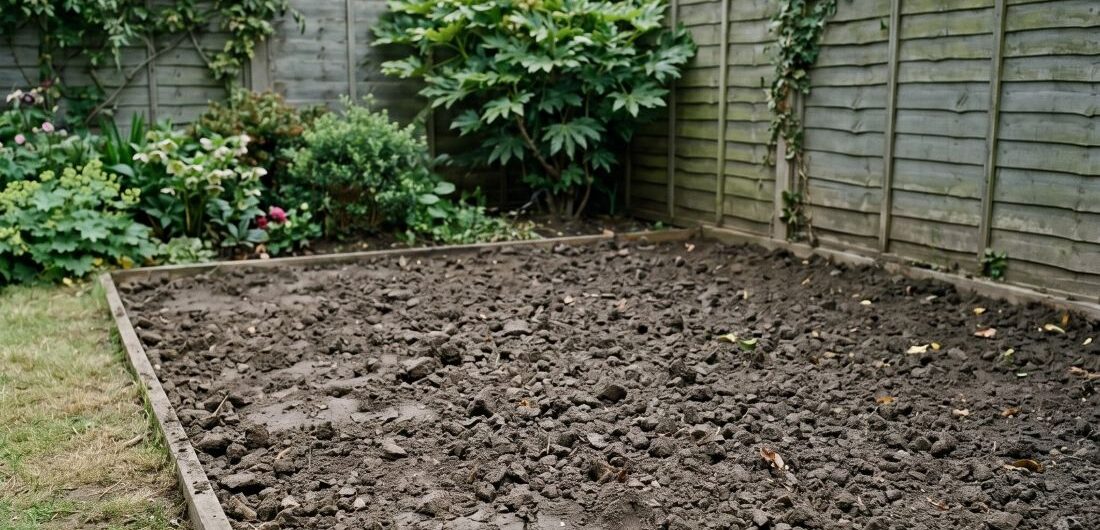
If you do only one thing for a clay garden, make it the annual addition of bulky organic matter. Well-rotted manure, garden compost and leaf mould all work by binding the fine clay particles into larger crumbs, creating the gaps that water and air need to move through. Spread a generous layer across the surface each autumn and let the worms pull it down for you – this no-dig approach avoids disturbing the structure you are trying to build and saves a great deal of labour. Over three or four years, a thick, sticky clay can become a dark, workable loam that holds the best of both worlds: good drainage and high fertility. Spent mushroom compost and composted bark are useful additions to the rotation, while sowing a green manure such as field beans or grazing rye on bare ground over winter adds yet more organic bulk and protects the surface from heavy rain.
It is worth knowing what not to do, too. Adding sharp sand or grit on its own is a common mistake, since small amounts mixed into clay can set harder still, closer to concrete than crumb. Coarse grit helps only when it is added alongside plenty of organic matter, never instead of it. Where waterlogging is severe and persistent, the most reliable answer is to lift planting above the problem with raised beds, or in extreme cases to install land drainage – though for the vast majority of London gardens, patient mulching does the job on its own.
The Best Plants for London Clay
The surest route to a thriving clay garden is to plant things that relish these conditions rather than merely tolerating them, and the good news is that the list is long and beautiful. Among shrubs, roses are the classic clay-lovers, their hungry roots perfectly suited to rich, moisture-holding ground; shrub and climbing varieties alike flourish where sandier soils would leave them parched. They are joined by reliable performers such as viburnum, philadelphus (mock orange), weigela, flowering quince (Chaenomeles), spiraea and the winter-stemmed dogwoods (Cornus), all of which cope happily with heavy soil. Hydrangeas are especially at home, drawing on the steady moisture to fuel their large summer blooms.
For trees, scale matters in a London garden, so the most useful choices are those that stay modest. Hawthorn (Crataegus), rowan (Sorbus), crab apple (Malus) and the spring-flowering Amelanchier all establish well on clay and earn their place with blossom, berries and autumn colour. Hornbeam (Carpinus betulus) deserves a special mention – it thrives on heavy ground and makes a superb clipped hedge, a far better bet than beech where the soil stays wet.
The perennial palette is just as generous. Hardy geraniums, daylilies (Hemerocallis), Japanese anemones, bergenia, astrantia, persicaria and the late-summer fireworks of Rudbeckia, Helenium and asters will all settle in and spread. Lady’s mantle (Alchemilla mollis) and geum thread happily between larger plants, softening edges and filling gaps.
Shade is the other reality of many walled London gardens, and several clay-friendly plants positively prefer it. Hellebores, foxgloves, hardy ferns, the architectural leaves of Fatsia japonica and the early flowers of pulmonaria all settle into cool, moisture-retentive ground beneath walls and trees, turning an awkward corner into one of the most rewarding parts of the plot. Comfrey and the low carpets of ajuga and brunnera will knit together as ground cover in the same conditions.
Knowing what to avoid saves money and disappointment. The plants that struggle most on London clay are those adapted to hot, dry, free-draining homes – lavender, rosemary, cistus and many silver-leaved Mediterranean herbs will sulk and often rot over a wet winter, their roots sitting in cold, airless ground. The same caution applies to many alpines and to bulbs that need a dry summer baking to flower well. If you long for those plants, grow them in containers or a dedicated raised bed of gritty compost, and let the open ground carry the species that were made for it.
Living With Clay Through the Seasons
A clay garden runs to its own calendar, and working with that rhythm makes everything easier. Autumn is the season to plant, mulch and improve, while the soil is still warm and reliably moist; new shrubs and trees put down roots over winter and are far better placed to handle the following summer. Spring planting is fine too, provided you keep an eye on watering once the ground begins to dry. The depths of winter and the hard-baked weeks of high summer are best left for planning rather than digging. A thick mulch laid in spring pays off again here, slowing the summer drying that opens those deep cracks and helping the soil hold on to the moisture that is clay’s great advantage.
Lawns are often where clay frustrates Londoners most. Poor drainage leaves turf squelchy and prone to moss, while summer cracking can leave it patched and brown. Spiking the lawn each autumn with a fork or a hollow-tine aerator, then brushing in a sandy top dressing, gradually relieves compaction and helps surface water clear. It is slow work, but it steadily improves a struggling lawn rather than masking the problem.
Most of all, a clay garden rewards patience. The early seasons can feel like hard labour for modest returns, yet every barrowload of compost and every autumn mulch is an investment that compounds. Within a few years the soil grows darker, looser and easier to plant, and the species that suit it begin to thrive with very little intervention. The heavy London ground that once seemed an obstacle turns out to be the foundation of a garden that is lush, resilient and quietly self-sufficient.