The Best Climbing Plants for Shady, North-Facing Walls in…
A high north-facing wall has a reputation among London gardeners as a lost cause – a cold, sunless expanse of brick that nothing worth growing will touch. Behind a Victorian terrace, or hemmed in by neighbouring buildings, it can feel like the one corner of the garden that refuses to come alive. Yet the truth is far kinder. Some of the most beautiful climbers in cultivation are woodland plants at heart, perfectly happy with their roots in cool shade and their stems pressed against a sunless wall, and a surprising number will flower there too.
The trick is to stop fighting the conditions and start choosing for them. A north wall in London has two things going for it that gardeners elsewhere would envy: the shelter of surrounding buildings and the gentle warmth of the city itself, which takes the edge off hard frosts. Pair that with plants well suited to shade, give them a decent start, and a blank, gloomy wall can become the lushest, greenest part of the whole garden.
Why a North-Facing Wall Is an Opportunity, Not a Problem
It helps to understand what a north-facing wall actually offers a plant. It receives little or no direct sunshine through the year, so it stays cooler and more evenly moist than a sun-baked south wall, and the light that reaches it is soft and indirect rather than fierce. The one real drawback is at ground level, where the wall casts a permanent rain shadow and the soil at its foot is often surprisingly dry, even after a wet London week. That single fact accounts for most of the failures people blame on shade. It is also worth distinguishing degrees of shade. A north wall in an open garden still receives plenty of bright, indirect light and will support a wide range of climbers, whereas a narrow side return between tall London terraces can be deeply shaded, and there the toughest evergreens and the most shade-tolerant foliage plants are the safest bet.
None of this troubles the right plants. A great many climbers are, by origin, woodland-edge species that spend their lives scrambling up through trees from shaded, leaf-littered ground towards the light above. Cool roots and low, dappled light are exactly what they evolved for, and several flower perfectly well without ever feeling direct sun on their stems. London adds two further advantages. The shelter of surrounding terraces and garden walls keeps off the worst of the wind, and the city’s own warmth, the urban heat that holds the capital a degree or two above the surrounding countryside, softens the frosts that might trouble a borderline plant in a colder county.
The shift that makes everything easier is one of expectation. On a north wall, foliage and structure do much of the work, and a wall clothed in glossy evergreen leaves or blazing autumn colour is a fine thing in its own right. Flowers become a welcome bonus rather than the whole point, and as it happens, several of the best shade climbers are generous with those too. A reliable approach is to give the wall an evergreen backbone, whether ivy, star jasmine or one of the evergreen hydrangea relatives, and then thread a seasonal flowering climber such as a clematis or a rose through it, so that the wall holds its interest the whole year round.
Self-Clinging Climbers That Need No Support
The least demanding option for a bare wall is a self-clinging climber, which attaches itself directly to the masonry by aerial roots or adhesive pads and asks for no wires, trellis or tying in. For a shady wall, the outstanding choice is the climbing hydrangea, Hydrangea anomala subsp. petiolaris. It is deciduous, slow to settle, and worth every season of patience: once established it covers a large wall in handsome heart-shaped leaves and broad, lacy white flowerheads through early summer, thriving in exactly the cool, sunless position that defeats lesser plants.
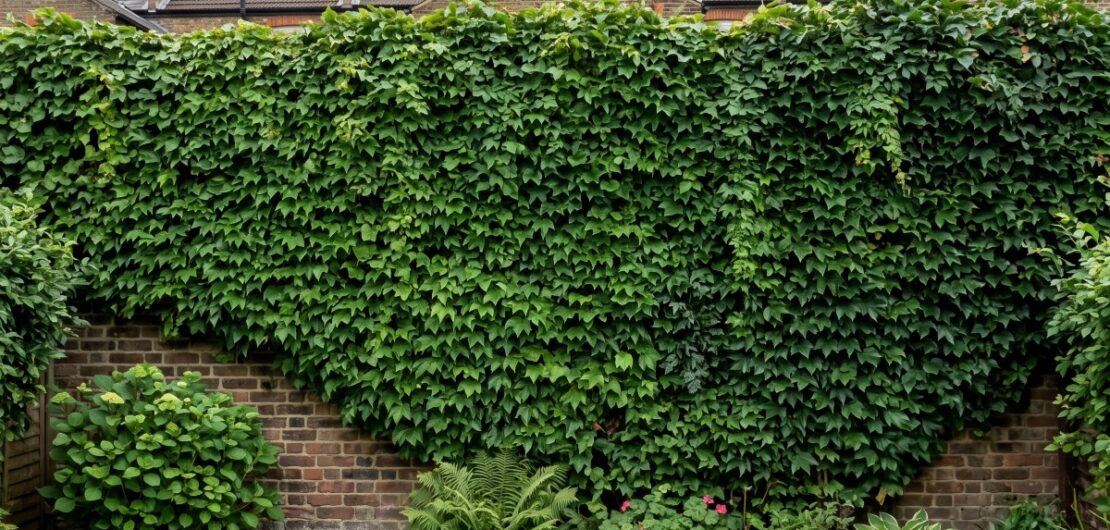
For sheer drama, the self-clinging Virginia creeper and Boston ivy, both forms of Parthenocissus, turn a whole wall to fire in autumn and tolerate deep shade without complaint, though they are vigorous and deciduous, leaving bare stems through winter. At the rarer end, Pileostegia viburnoides offers a refined, slow-growing evergreen relative of the climbing hydrangea, with leathery leaves and creamy late-summer flowers that hold a sunless wall beautifully all year. Two further self-clingers are worth knowing. The Japanese hydrangea vine, Schizophragma hydrangeoides, is a close and equally shade-happy cousin of the climbing hydrangea, while the evergreen Euonymus fortunei, more often grown as ground cover, will quietly climb a shaded wall and clothe it in dense, glossy leaves. Both are slow to begin but long-lived once settled.
Ivy and Your Brickwork
No plant divides opinion quite like ivy, and on a shady wall it is unbeatable for reliability – evergreen, fully shade-tolerant, and available in everything from large glossy leaves to delicate variegated forms. The common worry is damage to the wall, and it is worth being straight about it: on sound, well-pointed brickwork ivy clings harmlessly to the surface, but where mortar is already loose or render is cracked, its roots can work into the gaps and make matters worse. The sensible approach is to grow it only on walls in good repair, keep it clear of gutters, window frames and the roofline, and clip it over once a year to keep it dense and under control. Treated that way, it is one of the great problem-solvers for a dark corner.
Climbers and Wall Shrubs That Need a Little Support
Beyond the self-clingers lies a much wider choice of plants that will thrive on a north wall once given wires or trellis to hold on to. Among clematis, the early-flowering alpina and macropetala types are made for cool, shaded walls, shrugging off cold aspects to produce nodding spring flowers, while the popular ‘Nelly Moser’, whose pink bars bleach in strong sun, holds its colour best out of direct light. The vigorous Clematis montana will smother a large wall in late-spring blossom and tolerates a good deal of shade, asking only for room to roam.
Roses surprise people most. Several climbing varieties were bred for, or have long been grown on, sunless walls: ‘Madame Alfred Carrière’ is the classic, an old, vigorous climber carrying fragrant blush-white blooms through the season, while ‘New Dawn’ offers tough, pale-pink repeat flowering, and the thornless ‘Zéphirine Drouhin’ brings scent to a shady spot. None will flower quite as freely as it would in full sun, but all earn their place.
Other twiners worth a north wall include the woodland honeysuckles, which like their roots in shade, and the unusual chocolate vine, Akebia quinata, semi-evergreen and vigorous. Star jasmine (Trachelospermum jasminoides), the evergreen, sweetly scented climber seen all over London, will also cope with a sheltered north wall in the city’s mild conditions, though it flowers more shyly out of the sun. Where you want structure rather than a true climber, wall-trained shrubs excel in shade: the winter catkins of Garrya elliptica, the berries and evergreen cover of pyracantha, and the cheerful yellow winter flowers of Jasminum nudiflorum all take a north aspect happily when tied to supports. Flowering quince (Chaenomeles) belongs in the same group, studding a shaded wall with red, pink or white blossom in early spring before much of the garden has woken up, and the herringbone branches of Cotoneaster horizontalis will cover a low wall with shade-tolerant foliage and bright autumn berries that the birds strip within weeks.
Giving Shade Climbers the Start They Need
For all the right plant choices, most disappointments on a north wall trace back to that dry strip of soil at its foot, and a little care at planting time settles the matter for good. Set new climbers at least 30 to 45 centimetres out from the base of the wall, beyond the worst of the rain shadow, and lean the stems back towards it so the roots sit in ground that actually catches the rain. Enrich the planting area generously with garden compost or well-rotted manure, which on London’s heavy clay soils both feeds the plant and improves the moisture the roots can draw on through summer.
The first two summers are the ones that count. Water deeply and regularly until the climber is clearly established, since a plant in a rain shadow cannot rely on showers alone, and keep a thick mulch over the root area to lock that moisture in. A spring feed of a general fertiliser, worked in beneath that mulch, repays itself in stronger growth, particularly for the hungrier roses and clematis, which flower more freely for a little extra nourishment in a position that already asks a lot of them. Anything that is not self-clinging will need something to grip, and a simple grid of galvanised wires held off the brick on vine eyes is neat, durable and all but invisible once the plant takes hold, as well as far kinder to the wall than nailing up flimsy trellis.
After that, patience does the rest. A climbing hydrangea may sulk for a year or two before it races away, and most shade climbers build slowly before they cover their allotted space. Tie in and guide the stems while they are young, prune lightly to shape, and within a few seasons the cold, bare wall that once seemed a write-off will be the part of the garden that visitors notice first.